Wednesday, March 13, 2013

The Power of Books

Trying to organize, arrange, and stock a library at my school has become my biggest project. It consumes my free periods during the day, my Google searching when the hours of school have come to an end, and my brainstorming in the evenings and on weekends. It's become important to me because I've tried to think back and imagine my school years without a library, without books, and without imagination. I can't. And I'm glad. Kids should have access to that kind of knowledge, adventure, excitement, and control. It pains me all the more that most kids in my village haven't and probably won't have this outlet in their childhood and adolescence. Hopefully my school will be different, though.

In the past week and a half, I've seen just how powerful books are, especially to those that have never had them before. Back track to last week, beginning with Monday March 4th. I've been fortunate to have received some books from friends and family back home. I have a total of twenty four books that I compiled into one of the USPS boxes that transported them to me across the ocean. There are about three or four chapter books that are too hard for my learners to read, a bunch of kids books, an I Spy book, and a "My First Encyclopedia." We have obligatory "reading for enjoyment" by the Department of Education, regardless of the fact that we don't even have enough textbooks for a single section of a grade. Anyway, I've told my two sections of Grade 6 that they will get the books twice a week: 6A gets them on Mondays and Wednesdays, and 6B gets them Tuesdays and Thursdays. 6A is better behaved and always more engaged than 6B. I don't know what accounts for the difference, but that's how it is.

Tuesday the 5th was 6B's first day with the books. I figured they'd spend more time talking and hitting each other than paying any attention to them, which is usually how things go when there is no class going on. However, I was pleasantly surprised. I put the box on a plastic chair in the front of the room and told them they were free to come and take whatever they wanted. They stormed the box and all the books were gone in a matter of seconds. There are more boys than girls in 6B and most of them are way far behind, so they usually just stare at me when I ask questions. All of these boys had gathered into a couple of desks in the back corner and were sharing the "My First Encyclopedia." I've never seen them so focused on anything before. The benches usually sit two learners, comfortably. The boys were sitting three, sometimes four to a bench. They shared this book amongst the dozen or so of them, flipping through and stopping to laugh at animals and point at maps. "Miss, this is a monkey or a baboon?" they ask. "Look, a lizard!" I sat down on a bench next to the boy who can barely utter his name in an English sentence. He was holding the I Spy book, trying to figure out what to do with it. I showed him the pictures on the left and how he was supposed to find those same pictures in the bigger, more cluttered picture on the right. He completed the first page after a few minutes. The smile on his face completed my day. He had conquered a page of this book. And while it isn't the conventional book, it's still a start right?

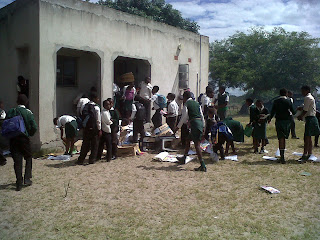
Fast forward to the beginning of this week. The ugly cement storeroom across the way from the office where I spend my time planning was calling my name. I'd piled up a couple hundred books outside the door that were entirely useless: workbooks in Afrikaans, books from the 90s that had been eaten by mice and served as homes for the largest cockroaches I've ever seen, etc. The groundskeeper Mr. Tembe asked me what we was to become of these books, as I was running out of space. I went to ask the principal and he said "those books that we cannot use, we must burn." I was slightly shocked to hear this, especially considering the Limpopo textbook scandal of the not so recent past: newly delivered textbooks in Limpopo province were found thrown in rivers and discarded, while schools had no books to use for classes. South Africans (especially schools) have a really difficult time parting with things, mostly for fear of whoever the higher-up is; in this case, "the Department." Not long after the principal came over, my counterpart walked in. Goodness Bongekile (better known as GB) is the one teacher at my school that I can always rely on. She rounded up six boys from Grades 6 and 7 and the floor of the storeroom was cleared in a matter of two days. As more learners started to come out of their classes, a mob had formed by the door to this cement eyesore. The boys were carting the books to the fire pit, but were intercepted by the mob. I've never gone anywhere near a store or shopping mall on Black Friday (nor do I ever plan to), but this is what I imagine it to look like. These books were being discarded because they are old, eaten and dirty, and written in a language that no one in this area speaks. But that didn't stop kids from fighting each other (sometimes literally) for these books. I watched little kids in Grade 3 or 4 holding Maths workbooks written in Afrikaans, Life Orientation books for Grade 6, Grade 1 textbooks with yellowed pages. The looks on their faces as they sat down under a tree and opened these books are ones I will never forget. I guarantee most of them couldn't read a word of what was on the page in front of them. But the fact that they had a book (one they could call their own) was more important.

A few wonderful girls in my cohort are putting together a Books for Africa project, whereby participating schools (after raising the money needed) will receive roughly 730 books for their library. The slogan for this project is "Today a Reader, Tomorrow a Leader." I'm a big fan.

Is this a plug for throwing some books in the mail for me to add to this project? Maybe. Is this an undertaking and a series of mental images that I will always remember? Probably. Is this concrete evidence that kids need to have books, and need to be able to read and laugh and write about them? Most definitely.

Thursday, February 21, 2013

House & Home

There are tons of things about this country and this culture that drive me crazy. But there are also those that I really admire. The concepts of family and where you live are a couple of them.

This afternoon I struggled and scrambled to try and come up with a lesson plan for an informal remedial English class that I'm going to start having on Friday afternoons in the hour that is taken to sweep and scrub classrooms instead of teaching. I wanted the lesson to be useful, but not too hard or too easy. Do I start with basic phonics? Do we read a story? Do I jump right into sentences that begin with "I like…"? I finally settled on a Little Bear book, illustrated by Maurice Sendak. The English vocabulary of some of these kids is so low, that I ended up making a list of probably half the words in the section that we're going to read, with its Zulu translation. I got to the word house and was momentarily stuck. While house and home aren't all that different, people don't use "house" here. It's all about "home." Maybe that's to account for all the different structures that people live in (rondavals with thatched roofs, cinder block houses like mine, or those that are made of reeds and mud) or maybe it's more of a feeling thing. In the United States, we refer to where we live as a house. It's a structure that provides shelter. We use home to decorate our walls with little ornaments that say "home is where the heart is" and welcome mats to wipe our feet that say "welcome to our home," but generally, I think that's about it.

Going back to translation issues, the same thing comes up when discussing family members. Very few people use the words uncle, aunt, or cousin here. Family is extended beyond the nuclear. Your parents' siblings are your mom or dad, even if they didn't give birth to you. Your siblings' kids are your own kids. A teacher that I wait for a ride with in the morning introduced me to her "daughters" the other morning. In the past, she told me about her daughter who is my age, who is attending university. So who are these two school age girls? "They are my sister's children." Gotcha. The same goes for siblings. Kids don't talk about their cousins. You ask them how many brothers and sisters they have, and you get a double-digit response. Even greeting people on the street, in the taxi, or at the grocery store: everybody is everybody's bhuti (brother) or sisi (sister).

I arrived home from gallivanting around KZN at the beginning of January to find a new structure built next to my house. It was for my brothers, and now I had three of them living at home instead of the two that I had left on 30 November. I returned home to meet Siyanda, 21 years old, in Grade 11. In talking with my baba, I learned that Siyanda is one of baba's nephews. Both of Siyanda's parents passed away a few years back. What he did up until now, I'm not sure, but he lives here, has school fees paid for, and is the best with little kids. He knocks on my door every so often to check in, say hello, ask me how my day was. I watch Generations every night with the boys in their house and we chat about school and life. I said house when I should have said home.

I was talking with my brother Derek lately about our different views on money and its importance to us. "I want to have a nice house and a nice car when I'm older. Is that bad?" Derek asked. "I feel like money isn't a big deal to you. It doesn't hold as much importance." I told him that living on a ~$320 monthly budget does that to a person. "No, I'm not just talking about now; you were like that when you were home here too." Maybe I was. I think this journey is making that more apparent to me. I do want a house someday. But more than just a protective roof over my head, I want to have a home.

Tuesday, February 5, 2013

School Days and Soccer Games

This past Friday, I got approved leave from school to go to Durban a day before me and some other volunteers had tickets to see the AFCON quarter final game at Moses Mabhida Stadium. It was great because I've been dreading my classes for at least a week now. The game was exciting because we bought tickets before we knew who would be playing, and South Africa's national team, Bafana Bafana, was one of the competitors. Unfortunately, they lost to Mali in penalty kicks, after two overtimes and a serious edge-of-your-seat game. I sang the South African national anthem with a sold out stadium (built especially for the 2010 World Cup), sat in the seventeenth row (and near-ish to South African President Jacob Zuma), and was slightly deafened by the competing sounds of Mali fans' drums, South Africa fans' vuvuzelas, and the handheld siren that the guy behind me thought it would be a good idea to bring to the game. It was a lovely weekend, and really nice to meet up with volunteers from other regions to talk about life and school thus far.

So back to school. We've had months of training, been given all the worst case scenario stories, and planned until we can't plan anymore. Every day since Wednesday January 16th has been a challenge in one way or another. In a period of seven days (including the weekend) I cried two or three of those days after school. Everyone told us our learners would be below their grade level, but I never imagined they'd be this behind.

The being behind is only one of the issues. My style of teaching is different than anything they've ever seen or dreamed. On the first day when I replicated the "getting to know you" game we played in Atlanta (where you have to go around the room and fill in people's names next to things that they have or have done) and tell them to walk around and talk with other learners, they stared at me: half in confusion and half in terror. Being told to talk to each other during class is foreign. "Chalk and talk" is how things work here: a teacher writes notes on the board, and learners copy without question or explanation. When they're given exams, the questions are word-for-word copied from the notes. It's a memorization game, not one of reflection and application.

Speaking of games, here's the favourite one of this system: presentation over content. All of us in SA26 are subject to follow the new curriculum CAPS. Under CAPS, my grade 6s are required to complete ten formal assessment tasks in Term 1. Term 1 began on January 16th and ends on March 28th. Some of those tasks include "performs a poem or song with oral comprehension," "reflects on stories/text read independently," and "writes three paragraphs based on the theme of the story." There are a few problems with these tasks, which are just three of the ten they are expected to have completed come 28 March. One: why are we worried about performing a poem when we can't even read it? Two: kids don't read independently here. There are no books available at school (we don't have a library, but hopefully by the time my two years are up, we will) and I'm sure an overwhelming majority of these kids have never had a book they can call their own. Three: a lot of my kids can't formulate a logical sentence about their favourite colour. How in the world are they supposed to decipher the theme of a story and then write three paragraphs about it?

Being behind: I've started doing journals twice a week with my grade 6 classes. It has so far proved to be the only thing that has gone successfully in these past weeks because it is so individualized. However, it has showed me that a handful in each class cannot write me a correct sentence telling me what colour they like most, or what their mother's name is, or what they like to do at home. In the same vein, they cannot ask me my brother's name, what I like to eat, or how old I am. Don't get me wrong, I can decipher what they're trying to say, but I shouldn't have to at this point in their education. These questions are basic and should have been covered a long time ago. This education system is a disaster, and I'm here trying to pick up the pieces for the 66 kids that I see everyday for an hour.

I have been feeling so demoralized lately. I am putting all of my heart and efforts into planning classes that I feel are far too basic for grade 6: what is a noun? What is the past tense of go? Write a sentence using "like" in third person. All of these were followed by blank stares. I have been going to school since January 16th and just looking at my learners as they stare back at me. It really makes me question what the hell I am doing here in the first place.

I was talking to a fellow volunteer about this recently, how we're both (how we're all) really struggling. How we stare at our notebooks as we try to plan lessons that someone will be able to understand and grasp. How it's hard to get up and face the day when everything is sucking so much. And how we need little glimpses of that lightbulb going off in somebody's head to keep us chugging along; we need something, anything, positive to happen to restore a sense of hope and purpose to our job.

That moment happened for me today. Both of my classes went well, but it was when I was reading "The Enormous Crocodile" by Roald Dahl to them that I really felt it. (No one has ever read to these kids, so at first, they stared at me confused, and then began to chat.) For those that haven't read it (I'm only halfway through it myself), the story is about a crocodile who wanders through the jungle on his way to town so he can eat some "juicy, little children." He meets different animals along the way, and he tells his plan to each of them. They are all horrified, and tell him how horrid he is for doing such a thing. The book I have is beautifully illustrated, which has been maybe the biggest contributor to my learners' comprehension.

Today I walked up and down each row holding the book out to show how the Enormous Crocodile chomped on the tree that a monkey was sitting in, but the monkey was quick and jumped to another tree before he was eaten himself. Uproarious laughter. They reached out to touch the crocodile's sharp teeth on the smooth page. When the crocodile disguised himself as a small coconut tree to fool the children, one learner goes "the crocodile is so clever!" At the end of class, half of them gathered around the book to read it on their own and touch the pictures. One asked me if he could borrow the book. I had to say no because I need it to plan tomorrow, but the fact that he wanted to take a book home to read or look at or share with his family both makes me smile and breaks my heart. It makes me happy that (slowly but surely) I'm getting through to some of them. But it chokes me up to think that I'm the first person exposing them to listening to a children's storybook, that they don't have access to reading and books at school or at home, and that this is such an easy fix if begun soon enough in their years of schooling.

The positive was saved for the end this time. And I'm glad today happened, because otherwise it would have been entirely negative. A lot of my days make me feel helpless and useless, and I really struggle sometimes. But as much as it sucks, knowing that I'm not alone in my uphill battle makes it feel slightly better. And days like today totally invalidate all my other doubts about my presence and my impact. They're small and often sporadic, but days like today keep me going.

Also, at the end of my second class, two girls that sit at one of the back corner desks gave me cards they made. They both had the same message: good day miss thandi/hi miss diana I love you I like you you are everything in my heart you are so pretty, kindness you are so perfect, so patient you are the kind ness women you are the best teacher you are so beautiful I so happy miss diana good bye miss. Day made x2

*** This is a plug for books. If you can send me little, illustrated books by Roald Dahl, or anyone similar/similar reading level, please do. Throw them in a bubble mailer and mail it here. I received one last week with two hardcover books. The postage cost $11.26. Can you swing $12 postage and a few bucks more for a couple books? Please and ngiyabonga (thank you). ***

Saturday, January 5, 2013

This is the New Year: Reflections & Resolutions

I'm finally back home at site after over a month of being away. I've slept in half a dozen different beds, on the ground, in caves, and under the stars, and it's nice to be back in my own, DoE rock-like bed. Since 30 November when I left for the beginning of In-Service Training, I think I've learned a lot. Obviously about the content that was presented to us from 30 November to 13 December at training, but also on a more personal level. I realize now how much I missed my South African family, and how much they missed me while I was gone. I hugged both of my host parents for real, not just out of being nice after having met them for the first time; my frail but strong gogo (grandmother) smiled and told me I looked muhle (beautiful); and my siblings wanted to know all about how my holidays were. I received phone calls from teachers that I had given my number to but never heard from in the past. I realize just how hard it is to transition back into regular American English after having spoke in "village voice" for so many months (enun-ciating ev-ery sin-gle word to make sure you are ful-ly under-stood). And I realize how much I missed Will after only having BBM to communicate from early September to early December.

In three short months, each of us has changed; some more drastically than others. At Pre-Service Training (PST), we were asked to make an Identity Map at one of our sessions highlighting how we identified ourselves at that point in time, only a few short weeks into our new adventure. We did the same exercise at IST, later comparing it with our first one. On my first map, I had "white" and "woman" in two different bubbles. This time around I had "WHITE WOMAN" in one bubble. Not to say that my race and gender weren't visible before, but now they both seem to be in my face at all times. Sexual harassment incidences in Peace Corps countries on the continent of Africa are highest in South Africa. I don't say that to freak anyone out (mom, dad, and family back home), I'm just telling it how it is. Unwanted attention, marriage proposals, and a proposed scenario of "friends with benefits" are all examples of sexual harassment, and have each happened to me so far at site.

On my first map, I had "daughter" and "sister" in a single bubble encompassing family ties. The updated map had "daughter," "sister," and "granddaughter" each in their own bubbles. Who I am as a daughter and a sister with my host family is slightly different; I have a relationship as a child to be protected with my host parents, and a relationship of joking, secret-sharing, and Generations-watching with my siblings. I haven't had a grandmother since I was ten years old, so it was really interesting to think of myself as a "granddaughter" once again.

The "college graduate" bubble didn't seem like such a big deal when I included it on my first map. In order to qualify for Peace Corps, you have to have a Bachelor's degree in something relevant. So I was no different than the next person. In my village and at my school, I feel like that bubble makes me stand out. Some teachers at my school have no degree whatsoever; others just took their exams and were receiving their results in mid-November. They come to me to ask what a word means, or if they are correctly constructing a sentence, or if I can explain an entire lesson to them so that they may later teach it to their class. In one region where our SA26 cohort is assigned, five incoming volunteers were told that they made up something like 1/6 of the college-educated inhabitants in the area.

On my first map, my central bubble read "Diana." My new middle bubble reads "Diana Pitcher / Thandi Mngomezulu," taking into account my American and South African names and families.

Having been gone for a month has allowed me to see other parts of this country and how they work: taxis that can and can't be relied upon in villages versus cities, the feeling of accomplishment after hiking up Masubasuba Pass from South Africa into Lesotho, and the genuine kindness and hospitality of complete strangers. Coming back has also given me time and experience to reflect on things I want to change: my biggest resolution for the New Year is to be more patient. Honestly, that is going to be a huge undertaking for me, as a person who likes to see things get done in a timely manner, and more so as an American. Life here is slow and more time is wasted waiting for a taxi to fill up or for someone to show up for a meeting than the time it would take to complete the task at hand. Learning patience here of all places will do nothing but benefit me in the long run. My other resolution has to do with fitness and exercise (and is realistic!). After five days of hiking, climbing, walking, falling, drinking lots of stream water with iodine tablets, and sleeping on the ground, I felt generally amazing (except for extreme sleep deprivation). I want that feeling to last, not for it to be a fleeting, once a year occurrence when my muscles are sore. I am going to start the Insanity fitness program all over again. I am also going to start running with my host dad in the mornings before school. I think this will help to get me into a routine of fitness, but also a general routine for school, sleep, etc. And finally, I want to be a good teacher. I have no formal training as an educator, and have only previously worked in small groups or individually. I want my students to succeed and feel confident about their work and about themselves. I'll let you know how we're doing a few months from now…

Saturday, November 24, 2012

Thanksgiving

This was the first Thanksgiving that I didn't spend on Long Island with my family. Instead, I spent it surrounded by gum trees, gas burners, and my north KZN Peace Corps family. Our dinner was potluck style (like all Thanksgiving dinners should be) and everyone did their best to recreate favorite dishes from home, or something that represented harvest food. Someone had sweet potatoes covered, so I didn't make my favorite dish made by my mom each year: sweet potatoes with apple slices and cinnamon. Sorry Michael: the sweet potatoes were good, but not as good as what I know my family in New York enjoyed on Thursday :)

I brought apple and pear crisp. Others brought green salad, beets, stuffing, green bean casserole, mashed potatoes, and chicken to replace the lack of available turkey in the area. This year Thanksgiving was spent with two families: the Peace Corps family and Briana's South African host family.

This holiday is not celebrated here, obviously because there would be no need for South Africans to rejoice in the arrival of the Pilgrims to the east coast of the United States centuries ago. We did our best to show them what it is all about for us. When everyone arrived, we were asked to make a hand turkey. You remember this from elementary school: trace your hand, each finger is a feather, the thumb is the head. I was part of the last group to arrive, and worked together with B's seventeen-year-old host brother Sphamandla on his. "What do I do now? Why are you coloring that in?" We each wrote our name on our hand turkey and Bostick'ed (sticky putty) them to the wall of the living room. (Picture below!) On a separate sheet, as each person stuck their turkey to the wall, they were also asked to list one thing that they were thankful for. The page was full of different colored gel pen responses in different sizes and handwritings.

One of Peace Corps' three main goals for its volunteers is that they share American culture with those that they live and work with. This Thanksgiving after all the love and support that our host families show us, we gave back to them and demonstrated just how thankful we are for their welcoming us into their homes and their lives.

This Thanksgiving, I am thankful for all the usual stuff: family, friends, health, happiness. But I think more than anything at the moment, I'm thankful for all the people that have opened up their arms, their homes, and their lives to me these past few months. Obviously I'm talking a lot about my host family the Mngomezulus here, but also the staff at my school who treat me like and refer to me as their daughter. To the learners who laugh at me when I attempt to communicate with them in Zulu, come to me with list of English vocabulary words that they want to know, and ask me if we can go to the storeroom to find a book to read. To the woman sitting at the taxi stop every morning on my way to school who yells "Good morning my friend!" as I pass by. And last but not least, to the other PCVs who have made me feel not so alone when things are tough or not so far away when I need someone to share a story or a laugh with, whether you're telling me about an awkward moment created by your principal or how many bats you've killed in your home. Thank you for being my support and my encouragement.

Tuesday, November 20, 2012

Swollen Eyes, Swollen Heart

Yesterday was the second time I've been on the verge of tears at school. The first time, I actually cried alone in the store room where I said I was going to go organize old books and whatever else has been out there untouched for who knows how many years. That time was after having learned more about Blind Side's life and the specific reasons behind why he is so far behind in school. His mother is sick, and it became his responsibility to care for her at the expense of his education. He has worked to pay for every piece of clothing that he wears. And he still comes to school because he just wants to learn. I lost it, but contained myself until I was confined by the musty walls of my future library.

This time was different. We have morning meeting every day beginning at around 7:45. When learners arrive after it has started, they take a slightly longer way around the Foundation Phase block and file to the back of the line with the rest of their class. Yesterday a learner showed up only moments before the "going to class song" begun, in which each line for each grade marches off to their respective classrooms. This learner's eyes were so swollen I don't know how he could see what was in front of him. The song is being sung by the other grades, because all of his classmates in Grade 3 and the surrounding lines are too busy pointing and laughing at this one kid. He shuffled to his classroom and tried to hide his face by looking at the ground, but a mob formed and the laughter overpowered the voices of the Grade 6 and 7 singers. I felt sick to my stomach.

After invigilating (SA English for "proctoring") the Maths common paper exam, I went to the Grade 3 teachers and asked about this learner. "What happened to the one learner with the very swollen eyes?" I asked them. After a moment of hesitation I'm told that, "he fell." "He fell. …really?" I ask with doubt in my voice. "Yes. We sent him home. He is probably at the clinic now. He was climbing a tree and fell from it." Things I wanted to say: "Yeah. He fell from a tree. And landed only on his eyes," as well as 'I fell' or 'I walked into a door' are two of the most used excuses in domestic abuse incidents. But of course I didn't say these things, and instead felt helpless and heartbroken for the rest of the day.

This is not the first time I've seen learners show up at school with signs of aggression and violence leftover on their faces. I've seen some black eyes, some fat lips, and some scabs and cuts from God knows what. I have yet to see a learner (or a South African in general) who does not have a visible scar on their body. I obviously come from a place where this kind of behavior would land someone in prison, but I still can't fathom how a parent or a teacher could do this to a child and not feel sick with their actions. This behavior and acceptance of the behavior is the biggest and most difficult cultural difference for me thus far, and I can't think of any example that I will see that hurts more.

When talking with my counterpart about corporal punishment a week or so ago, he said that the Bible justifies hitting children. "It gets the confusion and badness out of them," he explained. Bull shit. This is just another example of my reasons for my intolerance for the Bible and religion, but that is an entirely different story. He says he won't hit children, but still justified it. I'm confused.

Yesterday after I invigilated the exam, I returned to the Grade 7A classroom where I spend most of my time and leave all my stuff. I found two sticks on my desk. I snapped them into three pieces each and loudly slammed them into the dustbin behind the door. A few kids looked at me in disbelief. I've said it before and I'll say it again: I will never, can never, hit a child. With a stick, with my hand, with anything. One of Peace Corps' three main points is sharing American culture with our host country and the people we spend our days with. I know that I can't change the entire system of education and discipline here, both of which frustrate me more than words can express. But I do want to show the teachers and learners at my school that learners can be disciplined without force and brutality and still turn out fine. I am an example of that. My country is an example of that. And if I can get through to a small fraction of the population through the individuals at my school, I will feel like I have achieved something really meaningful.

Thursday, November 1, 2012

Blind Side

I have spent the past two weeks at school with my counterpart teacher; he teaches Grade 6 English, which is what I'll be teaching next year. My Peace Corps assignment says that I must spend the day with him to get a feel for what being a teacher at a rural South African school is like. He also teaches three classes in Grade 7, so I've got to know the Grade 7s pretty well in a relatively short period of time.

This blog post is about one student in particular whose nickname is Blind Side. Blind Side is just under a year younger than my brother Derek. Derek is 18 and just began his first year of college in late August. Blind Side is nearing the end of Grade 7, which he will not pass. He is 17 years old.

The nickname comes from the 2009 movie of the same name. My Blind Side is slightly taller than his peers and has a much manlier voice. In the movie, the character "Big Mike" is huge in comparison to other kids, especially those in the family he is taken in by. He plays with and protects the smaller, younger children. He's like a big teddy bear. He works hard, and is awfully quiet.

My first day in Grade 7, I asked my counterpart about him because you can tell that he is older than the twelve year olds he is surrounded by. He told me, "that one is never going to proceed. He was in an accident and missed months of school. He suddenly came back one day and was put in Grade 7. He will never pass this grade." There are other kids at my school who are way too old for the grade they're presently in. There's a girl who has to be almost 10 in Grade 1, a boy who must be just about a teenager in Grade 3, and a 16 year old in Grade 4. How these things happen without intervention or some way to help these kids along, I'm not sure. So I've kept an eye on Blind Side these past two weeks to get a better idea of what he's all about.

He surprises me a little more everyday. The first time he stood out to me was on a day that has become all too common nearing the end of the fourth term: teachers write the exams that they will give their students during class time, and they tell the kids to "work on preparing for _____ exam." On this particular day it was "discuss your arts&culture exam." Why and how a class on arts&culture can have an exam, I'm not sure. "Discuss" is key for "talk about whatever you want for an hour." Most kids broke off into groups with their friends and did just that. Blind Side's seat is in the very back row during class. During this discussion period, he sat in the front row and worked with four or five other boys. They wrote notes in their exercise books and even stayed for five minutes after the bell for break to finish what they were doing. At one point during the period, a member of the group was distracted by another boy who thought it would be fun to start a small fight in class. Blind Side grabbed his group member's shoulder and hauled him back into their circle to keep working on their project.

Later in the week, I was told "you teach class today!" and given only a few minutes to pull something out of my ass to work on with these kids for English period that day. I went over to the cabinet (falling apart filing cabinet whose doors don't close) and pulled a book from the very back. It was a Grade 7 English book that had probably never seen the light of day, for reasons I can't understand or explain. I told them to open to a story about the importance of rainforests, particularly the Amazon in this story. Each learner read a paragraph and I wrote reading comprehension questions on the board after we talked about vocabulary that they weren't sure of. This didn't take the full period, and I left the books on the desks until the very end of class to see what the kids would do. I was pleasantly surprised to see many of them flipping through and reading stories that they found interesting. I was especially surprised to see Blind Side doing just that, mostly because his average in English class last term was 12%. He later took out a dictionary and flipped through that too. My mind = blown.

Two days ago was Career Day in Grade 7. You may be imagining what "Career Day" means in an American context, but it's not like that here. This version of Career Day was a day where learners were to dress up as their chosen career and speak about why they were interested in that career to the rest of the class. The largest group was educators (maybe because they all wore street clothes and because it was the easiest profession to pull off on the spot?) followed by social workers. Other careers depicted included doctors, police officers, nurses, farmers, TV presenters, electricians, traffic cop(per), and a nature conservationist. Blind Side had to be talked to by the principal and the other teachers in the room; not because he was misbehaving, but because he had to be told that he couldn't have more than one career. He wanted to be an electrical engineer and a carpenter, and even brought in an example of one of his woodworking projects to show. My counterpart told him he was "a jack of all trades" and he smiled really big.

His grades are low. And without proficiency in English, he will undoubtedly fail everything that comes his way. At Grade 4, testing turns over to English. It breaks my heart to think of him dropping out of school to find work because he gets stuck in the last grade of primary school. I'm going to try to pull him into my Grade 6 English class in January. I teach in a much different way than most others at my school, and I stop to explain things to individual students if they are struggling. I'm also planning on having a session after school once or twice a week for any learners that are having difficulty in English. His talent and passion are too much to let go to waste. I wanted to take the time to write about him because this job is frustrating. And some days I don't feel like going to school. But when you have learners like Blind Side, they make it worth every minute.